22
Jun
AI Software vs Traditional Software: What's the Difference?
Software is an important part of modern business. From managing customer information to organizing daily tasks, businesses use different types of software to make their work easier.
Over the years, traditional software has helped companies manage many activities. Now, Artificial Intelligence (AI) is bringing new possibilities to the world of software.
But what is the difference between AI software and traditional software? Are they completely different, or can they work together?
Let's understand both in simple terms.
What Is Traditional Software?
Traditional software is designed to perform specific tasks based on instructions and rules created by developers.
It follows predefined processes. When a user provides information or selects an option, the software performs the action it was programmed to complete.
For example:
Accounting software calculates totals and prepares financial records.
Project management software tracks tasks and deadlines.
Email software sends and receives messages.
Inventory software records products and stock levels.
Traditional software is useful because it performs predictable tasks in a consistent way.
However, it usually needs predefined rules to handle different situations.
What Is AI Software?
AI software uses Artificial Intelligence technologies to perform tasks that may require understanding information, recognizing patterns, or generating useful outputs.
Depending on its features, AI software can work with written language, images, documents, and other types of information.
For example:
AI writing tools can help prepare content.
AI chat assistants can answer common questions.
AI document tools can summarize information.
AI analysis tools can identify patterns in data.
AI automation tools can help manage workflows.
Unlike traditional rule-based software, some AI systems can respond to different inputs in more flexible ways.
However, AI outputs are not always correct and should be reviewed when accuracy matters.
1. Understanding the Main Differences
The biggest difference is how these two types of software handle information and tasks.
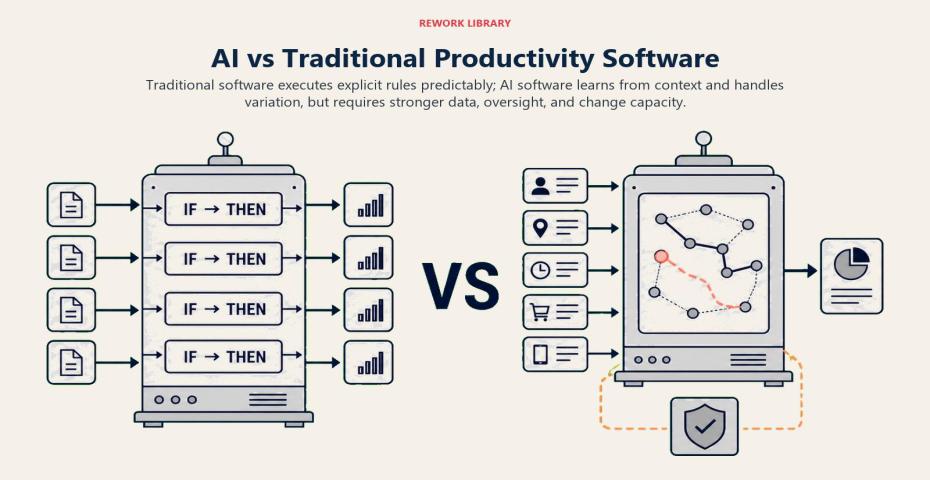
Traditional software generally follows predefined instructions, while AI software can use AI models to interpret inputs and generate responses.
Here is a simple comparison:
| Traditional Software | AI Software |
|---|---|
| Follows predefined rules | Can interpret different inputs |
| Performs specific programmed tasks | Can support more flexible tasks |
| Usually produces predictable outputs | Outputs may vary depending on the input |
| Works with structured instructions | Can work with language and other complex data |
| Requires updates to change programmed behavior | May use updated models or configurations |
Both types of software have important uses. The right choice depends on the problem you want to solve.
2. How Traditional Software Helps Businesses
Traditional software remains essential for everyday business operations.
It is especially useful when tasks require clear rules, accuracy, and consistent results.
For example, a business may use traditional software to:
Calculate invoices.
Manage employee records.
Track inventory.
Organize project deadlines.
Store customer information.
Process standard business transactions.
These activities often follow established processes, making traditional software a practical choice.
3. How AI Software Helps Businesses
AI software can support tasks that involve understanding, generating, or analyzing information.
For example, a company may use an AI assistant to prepare email drafts, summarize long documents, or help answer common customer questions.
AI can also support business teams by helping them:
Generate content ideas.
Analyze customer feedback.
Organize written information.
Prepare document summaries.
Support customer communication.
Improve repetitive workflows.
The actual capabilities depend on the software and the AI technology it uses.
4. Can AI Software and Traditional Software Work Together?
Yes. In fact, combining both can be a practical approach for many businesses.
Traditional software can manage structured processes, while AI can support tasks that require interpretation or content generation.
For example, imagine a business that receives customer inquiries through its website.
A connected workflow could work like this:
Step 1: A customer submits a contact form.
Step 2: Traditional software collects and stores the information.
Step 3: An AI tool helps identify the purpose of the message.
Step 4: The system organizes the request and prepares a response draft.
Step 5: A team member reviews the response and contacts the customer.
This combination can make the process more organized while keeping people involved.
5. Which Software Is Better for Small Businesses?
There is no single answer because every business has different requirements.
Traditional software may be the better option when you need a reliable system for structured tasks, calculations, record keeping, or predefined workflows.
AI software may be useful when you need help with content creation, document analysis, customer communication, or interpreting information.
Some businesses may benefit from using both.
Before choosing software, consider:
Your Business Needs: Identify the problem you want to solve.
Ease of Use: Choose software that your team can understand and use comfortably.
Features: Check whether the software offers the functions you actually need.
Integration: Make sure it works with your existing applications.
Security: Review how business and customer information is stored and processed.
Cost: Compare subscription fees, usage limits, and maintenance requirements.
6. Is AI Software Replacing Traditional Software?
AI is changing software development, but traditional software is not disappearing.
Many everyday business systems still depend on predefined rules and structured processes.
At the same time, software developers are adding AI-powered features to existing applications.
This means future business software may combine traditional programming with AI capabilities.
For example, a project management application may continue to manage tasks and deadlines while also offering AI-generated summaries and suggestions.
The two approaches can complement each other.
7. What Should Businesses Consider Before Adopting AI?
Although AI offers useful possibilities, businesses should understand its limitations.
Accuracy: AI can generate incorrect information. Important outputs should be checked.
Privacy: Protect confidential business and customer information.
Human Oversight: Keep people involved in important decisions.
Training: Employees may need guidance to use new tools effectively.
Integration: Check whether AI features work properly with your existing systems.
Choosing technology carefully can help businesses avoid unnecessary costs and complications.
Final Thoughts
AI software and traditional software both play important roles in modern business.
Traditional software is useful for structured tasks and predictable processes. AI software adds capabilities that can help businesses work with information, create content, and support more flexible workflows.
Rather than thinking of them as competitors, businesses can explore how both technologies can work together.
At Japocode, our focus is on AI software, useful digital tools, and business automation. We believe the best technology is technology that solves real problems and makes everyday work simpler.
Japocode — Smarter Technology. Simpler Business.
Share
Latest blogs